Elder Master Keller Visit
Green Dragon Broadsword
November 14, 2026

Elder Master John Keller
Elder Master John Keller is a high-ranking martial arts master and the head instructor/founder of Idaho Shaolin (located at the Idaho Shaolin Center for Martial Arts in Boise, Idaho). He holds a 9th-Degree Black Belt in Shaolin Kung Fu.
Background & History
- Early Training & Beginnings: Born and raised in Boise, Idaho, Master John began his formal martial arts training in 1978. In 1980, he relocated to Denver, Colorado, where he commenced his training in traditional Shaolin Kung Fu.
- Lineage & Authorization: He trains directly under Grandmaster Sin Kwang Thé, the Grandmaster of the Shaolin Do system. Master John is authorized by Grandmaster Sin Thé to teach the complete Shaolin system, including Northern and Southern fist styles, classical animal forms, internal arts (Tai Chi Ch'uan and Chi Kung), and traditional weapons.
- Historic Milestone in China: Master John was part of a historic group of American Shaolin students who were among the very first foreigners invited to perform in a joint Kung Fu demonstration at the famed Wu Tang Monastery atop Wudang Mountain (Wu Tang) in central China.
- Founding Idaho Shaolin: In 1990, he established the Idaho Shaolin Center for Martial Arts on West Ustick Road in Boise, Idaho. Over 35+ years of operation, he has trained hundreds of students, guiding many to Black Belt, Black Sash, and instructor levels.
- System Curriculum: His instruction covers authentic Shaolin Kung Fu, internal energy cultivation (Chi Kung), Tai Chi Ch'uan, and classical weapons systems—including traditional Chinese broadsword routines.
- Practicality & Health: His school emphasizes internal health, traditional forms preservation, and practical real-world self-defense over sport or tournament competition.
What is the Green Dragon Broadsword?
1. Traditional Chinese Broadsword Forms & Lineages
- Hong Long Tan Tao (Red/Green Dragon Broadsword): In Northern Shaolin and 5-Animal Shaolin systems, "Dragon Broadsword" forms focus on dynamic footwork, fluid sweeping cuts, wrist spins, carry positions, and empty-hand strikes interspersed with weapon work. It is often taught as an essential foundational or intermediate set before moving into specialized blades like the Willowleaf Broadsword (Liu Ye Dao) or Rolling Thunder Saber.
- Green Dragon Crescent Blade (Qing Long Yan Yue Dao): In traditional folklore and martial arts, the long-handled broadsword (Guan Dao or Pu Dao) is famously known as the Green Dragon Crescent Blade, attributed to General Guan Yu. Modern heavy training broadswords and polearm broadswords frequently feature brass carved dragon-head handguards at the base of the blade.
2. Physical Sword Designs & Replicas
- LK Chen "Green Dragon" Dao / Jian: Replica forged blades modeled after mid-to-late 20th-century traditional Chinese swords. These feature high-carbon manganese spring steel blades paired with bright brass dragon-motif fittings and scabbard mounts.
- Custom Forged Tai Chi & Kung Fu Daos: High-carbon or folded-steel single-edged saber broadswords crafted with ray-skin wrapped hilts and engraved dragon guards designed for cutting practice (tameshigiri), forms demonstration, or display.


The Green Dragon Broadsword Form
The Green Dragon Broadsword (Qing Long Dao / 青龙刀) holds a rich place in Northern Shaolin and traditional Chinese martial arts, serving as both a legendary symbol of power and an essential advanced conditioning tool.
History and Origins
- Origins in the Shaolin & Northern Systems: The form originated as a specialized single-handed broadsword (single dao) routine within traditional Northern Shaolin lineages. It takes its name from the legendary Chinese Azure Dragon (Qinglong), representing the wood element, spring, growth, and fierce fluid energy.
- The "Green Dragon" Symbolism: In classical Chinese folklore and military tradition, the Green Dragon is closely tied to martial virtue, righteousness, and courage—most famously associated with General Guan Yu and his heavy polearm (the Green Dragon Crescent Blade / Guan Dao). In single-sword systems, the "Green Dragon" moniker was adopted for forms that emulate the coiled power, sudden lightning strikes, and sweeping aerial presence of a dragon.
- Transmission to Modern Systems:Within traditional Shaolin Do and Northern Shaolin lineages, the Green Dragon Broadsword form is preserved as a classical short-weapon form. It bridges foundational single-blade techniques with complex internal energy circulation and high-level footwork.
What the Form Trains
The broadsword is traditionally referred to as the "Marshal of All Weapons." While the straight sword (Jian) relies on delicate finesse, the broadsword relies on fierce momentum, body unity, and continuous defense.
- Wrapped-Head Technique (Chan Tou) & Neck Wrap (Guo Nao):
- Trains the student to maintain close, continuous protection over the head, shoulders, and spine using the back (non-sharp edge) of the blade.
- Coiling & Spiral Body Mechanics (Chan Si Jing):
- Emphasizes fluid, circular movement where power originates from the waist and root rather than just the arms. The practitioner moves like a coiling dragon, seamlessly shifting between open sweeping cuts and tight defense.
- Wrist and Forearm Conditioning:
- Due to the broadsword's weight distribution, executing fast circular maneuvers (Hua Dao) develops strong wrist flexibility, grip strength, and forearm endurance.
- Dynamic Stance Work & Agility:
- The form incorporates deep horse stances (Ma Bu), low bow stances (Gong Bu), and sharp directional changes to train balance, explosive leg power, and spatial awareness while maneuvering a heavy blade.
Learn More
Contact us for sign up information, weapons and further class instruction.
Historical Use of the Green Dragon Broadsword
1. Battlefield Utility and Military History
While legendary figures like General Guan Yu are famous for massive polearms (Guan Dao), ordinary foot soldiers, officers, and cavalrymen heavily relied on the single-handed broadsword (Dao) for close-quarters combat:
- The Ultimate Sidearm: Unlike spears, halberds, or heavy polearms—which were unwieldy in tight formations—the broadsword was the quintessential sidearm. It was rugged, easy to produce, and simple to draw quickly in a chaotic melee.
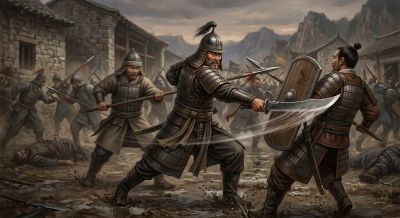
- Versatility Against Armor and Shields: The broadsword’s single-edged, curved blade with a weighted tip was specifically designed for hacking, slashing, and chopping. It could bypass or crack traditional leather and iron lamellar armor, and it was devastating against opponents using shields.
- Cavalry Tactics: During the Ming and Qing dynasties, military broadswords (often referred to generically as Dao or saber variants like the Nandao and later Dadao) were standard issue for cavalry units because a single-handed cutting weapon was effective when charging past infantry.
2. Evolution in Traditional Martial Arts & Shaolin
As firearms rendered swords obsolete on the battlefield, the practical combat techniques were preserved, refined, and codified into solo solo forms (taolu) within martial lineages like Northern Shaolin and Shaolin Do:
- Preserving Agility and Reflexes: Traditional forms like the Green Dragon Broadsword were created to drill the reflexes necessary for survival. The constant circular wrapping (Chan Tou) and shielding movements trained a soldier or martial artist never to leave an opening in their defense, even when attacking aggressively.
- Physical Conditioning: In historical training grounds, heavy training broadswords (sometimes weighted or longer than standard blades) were used explicitly to build upper-body strength, tendon resilience, and endurance. A practitioner who could effortlessly maneuver a broadsword through complex, high-speed patterns could easily adapt to shields, spears, or empty-hand combat.
3. Cultural and Symbolic History
Beyond physical warfare, the broadsword held cultural significance:
- Anti-Bandit and Militia Defense: Throughout rural China, village militias and traveling merchants relied on broadswords for self-defense against bandits. The aggressive, forward-moving nature of broadsword forms was favored for practical protection over the more delicate, court-oriented straight sword (Jian).
- Symbol of Courage: In martial arts philosophy, the broadsword represents the "General" of weapons—symbolizing bold, decisive action, unwavering courage, and direct confrontation of obstacles, much like the mythological dragon it is often named after.